
Pakistan’s Diplomatic Triumph: From the Swiss Negotiations to the Iranian President’s Visit – Part Two
By Asif Haroon Raja
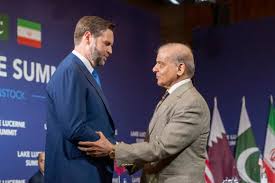
Visit of Iran’s President Pezeshkian to Pakistan
Asif Haroon Raja
Diplomatic Breakthrough in Talks
Negotiations in Switzerland continued for approximately 18 hours. The outcome emerged in the form of a joint communiqué, under which a basic agreement was reached for a period of 60 days.
Technical teams will now engage with one another to address and finalize the remaining issues.
Pakistan’s role in facilitating these critical negotiations marks the arrival of Islamabad as a credible diplomatic bridge between competing regional and international power centers.
At a time when confrontation, coercion, and military escalation seemed to be overshadowing diplomacy, Pakistan demonstrated statesmanship by providing a neutral and trusted platform for dialogue.
The success of the initiative reflected not only the confidence reposed in Pakistan by the concerned parties but also the effectiveness of the country’s civil-military leadership in navigating a highly complex geopolitical environment.
By helping to keep channels of communication open and encouraging a peaceful path forward, Pakistan reinforced its image as a responsible stakeholder committed to regional stability, conflict resolution, and international peace.
The diplomatic breakthrough has enhanced Pakistan’s stature and underscored its growing relevance in shaping outcomes on issues of global significance.
Tehran’s Acknowledgment of Pakistan’s Role
As the saying goes, a true friend is not the one who stands beside you only in good times; a true friend is the one who takes hold of the rudder when the storm is at its fiercest.
When the Iranian President arrived in Pakistan on Tuesday, it was not merely a diplomatic visit. It was also an acknowledgment of a major diplomatic achievement that has unfolded in the region over the past few months.
He came at a time when senior Iranian officials themselves were openly recognizing that Pakistan played a decisive role in the recent peace agreement and negotiation process.
Beyond expressing gratitude, the Iranian President’s visit also served as a symbolic repudiation of the anti-Pakistan propaganda that had been relentlessly circulated by hostile elements.
From the very beginning of the conflict, false reports were spread alleging that Pakistan had offered its territory to the United States for operations against Iran, in an attempt to drag Pakistan directly into the war.
Simultaneously, fabricated narratives were used to incite unrest, encourage street violence, and ignite sectarian tensions within Pakistan.
Those behind such campaigns feared Pakistan for one reason alone: Pakistan was the only country capable of disrupting the broader scheme aimed at setting the Middle East ablaze.
Time ultimately proved their fears justified. Pakistan succeeded in dismantling years of carefully laid plans.
Iranian Foreign Minister Abbas Araghchi, in his recent statements, praised the efforts of Pakistan and Qatar, noting that it was their diplomatic engagement that helped steer the region away from war and back toward the negotiating table.
The recent talks in Switzerland were also hailed as an important milestone, particularly regarding progress toward easing restrictions on Iranian oil exports and addressing the issue of frozen Iranian assets.
What makes this development remarkable is that only a few months ago, Iran was under immense pressure. Tensions around the Strait of Hormuz were escalating, oil exports were constrained, and Iranian assets remained frozen across various jurisdictions.
Very few observers could have imagined that the situation would change so dramatically within a matter of weeks.
Now, however, the picture is markedly different. The U.S. administration has announced temporary easing measures regarding Iranian oil and petrochemical exports. Access to certain frozen assets has begun to be restored, and Iran itself is describing these developments as a major diplomatic breakthrough.
It must be remembered that none of this happened overnight.
Behind these developments lies months of quiet diplomacy, shuttle diplomacy, and sustained engagement by Pakistan among Iran, the United States, Gulf states, and other stakeholders.
International media outlets have also acknowledged that Pakistan—particularly its diplomatic and military leadership—played a significant role in keeping negotiations alive and bringing the concerned parties to the same table.
This is precisely the role that I have consistently highlighted in my writings over the past three months, while the merchants of hatred dismissed such assessments with ridicule and mockery, allowing prejudice to triumph over reason.
It is because of Pakistan’s contribution that Abbas Araghchi extended special thanks not only to Pakistan’s leadership but also to its people, security institutions, and state machinery. In his words, Pakistan did not merely provide a venue; it played an active role in advancing peace.
For this reason, the Iranian President’s visit also carried a broader message.
In a region where Pakistan is often viewed solely through a security lens, the recent crisis has demonstrated that Pakistan is not merely part of the problem—it can also be part of the solution.
If Iran has received relief regarding its oil exports, if negotiations have resumed, if progress has been achieved concerning frozen assets, and if the region has been spared a major war, Pakistan’s role is visible throughout this entire process.
A Visit that Spoke Volumes
That is why this visit was more than a gesture of gratitude. It was a recognition of the fact that, in an evolving global political landscape, Pakistan has once again emerged as an important player on the diplomatic chessboard.
What Pakistan Seeks from Iran?
This naturally raises an important question: What does Pakistan seek from Iran in return?
Pakistan seeks nothing. Pakistan has previously extended every possible form of assistance to a neighboring Muslim country as well.
During the 1990s, when much of the world had turned its back on that neighbor, Pakistan stood by it.
In the early years of the twenty-first century, when global powers moved against it, Pakistan continued to support its leadership and remained engaged in negotiations until the very end.
Pakistan was among the first to recognize its government upon its restoration. Yet, the response was often marked by ingratitude and disappointment.
Today, Pakistan asks only one thing of Iran: that Iranian territory should not become a sanctuary for those hostile to Pakistan.
Iran is free to maintain relations with any country it chooses, but it must ensure that no external power is allowed to use Iranian soil as a base for activities that undermine Pakistan’s security and stability.
India Betrayed Iran
Iran has now been let down twice by India at critical moments. The recent developments should prompt Tehran to undertake a sober reassessment of its strategic relationships and carefully distinguish between genuine partners and opportunistic associates.
The question confronting Iranian policymakers is no longer whether India values its ties with Iran, but whether New Delhi can be relied upon when regional tensions reach a decisive stage.
Strategic partnerships are ultimately tested during moments of crisis, not during periods of normal diplomacy and trade.
Threat From Afghanistan Jointly Tackled
Another area where Pakistan and Iran have a strong convergence of interests is the security situation along their western and eastern frontiers.
Both countries face common challenges emanating from Afghan territory, including cross-border terrorism, militant sanctuaries, arms smuggling, narcotics trafficking, and the activities of hostile intelligence networks seeking to destabilize the region.
These threats do not recognize borders and have inflicted damage on both nations.
Rather than addressing these challenges separately, Islamabad and Tehran would benefit from establishing a more robust framework for intelligence sharing, border management, coordinated security operations, and economic development of the border regions.
A stable and secure Afghanistan is in the interest of both Pakistan and Iran, and cooperation between the two neighbors remains the most effective means of countering the forces of instability.
Regional Realignments
The ongoing regional realignment presents Pakistan and Iran with a historic opportunity to transform their geographical proximity, cultural affinities, and shared security concerns into a durable strategic partnership.
Mutual trust, sustained engagement, and coordinated regional policies can serve as the foundation of a relationship capable of contributing to peace, stability, and economic prosperity across the wider region.
Cooperation Within the Muslim World
The Muslim world, including Iran, has now witnessed a fundamental reality: when the wolves descend, Pakistan is often the country willing to go beyond its means to assist its brothers in distress.
If, under the influence of adversaries, one chooses to weaken or undermine that source of support, one risks extinguishing one’s own last ray of hope.
At the same time, Iran should also remember the role played by Saudi Arabia throughout this period. Riyadh could have chosen to exploit the situation to its advantage while Iran was facing pressure from multiple directions. Instead, Saudi Arabia prioritized regional stability and Iran’s security.
Whenever Pakistan required the support of a powerful partner at the diplomatic level, Saudi Arabia, Turkey, Qatar and Egypt stood shoulder to shoulder with Pakistan in support of Iran.
It is hoped that Iran will remember these efforts. In its difficult hour, its brothers went beyond their capacities to help safeguard its security and stability—and, ultimately, those efforts proved successful.
Recommendations
The greatest expression of gratitude between States is not rhetoric but the pursuit of policies that create enduring strategic partnerships.
If Iran wishes to acknowledge Pakistan’s support during a difficult period, the most meaningful response would not be symbolic gestures, but concrete steps that strengthen bilateral relations and advance shared strategic interests.
If Pakistan and Iran can transform recent diplomatic cooperation into long-term economic and security collaboration, both countries will emerge stronger and the entire region will benefit. Possible areas of mutual cooperation are listed as under.
First, Tehran could expedite the implementation of long-delayed energy cooperation projects, particularly the Iran-Pakistan gas pipeline and expanded electricity exports to Pakistan’s border regions. Energy cooperation would create lasting economic interdependence and benefit both nations.
Second, Iran could enhance intelligence and security cooperation along the Pakistan-Iran border. Both countries face threats from terrorist groups, separatist networks, narcotics traffickers, and transnational criminal organizations. Closer coordination would improve border security and deny hostile actors the ability to exploit either country’s territory.
Third, Tehran could adopt a more balanced regional policy by recognizing Pakistan’s legitimate security concerns and avoiding any alignment with policies or initiatives that undermine Pakistan’s strategic interests. A relationship built upon mutual respect and strategic sensitivity would strengthen trust between the two neighbors.
Fourth, both countries could expand trade, transportation, and connectivity projects linking South Asia, Central Asia, and the Middle East. The geographic locations of Pakistan and Iran provide a unique opportunity to become gateways for regional commerce.
Finally, Pakistan and Iran should work together to address the common challenges emanating from Afghanistan. Extremist violence, cross-border militancy, drug trafficking, and refugee pressures affect both countries.
Joint mechanisms for intelligence sharing, border management, and regional stabilization would serve the interests of both nations and contribute to broader regional security.
ConcludedAbout the Author
Brigadier (Retd) Asif Haroon Raja, SI (M) is a war veteran. He is Command and Staff Course and War Course qualified, holds an MSc in War Studies, and served as Defence Attaché in Egypt and Sudan, as well as Dean of the Corps of Military Attachés in Cairo.
He is a defence, security, and geopolitical analyst, columnist, featured columnist of IntelDrop magazine Washington, author of five books, former Chairman of Thinkers Forum Pakistan, Patron-in-Chief of Centre for Development Studies Think Tank, Director of Meesakh Research Centre; he regularly appears on media platforms.


