
Strategic Implications of U.S. Strike on Iranian Nuclear Facilities
By Zaheerul Hassan
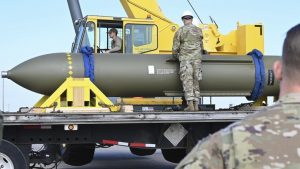
On the night of June 21 2025, United States Air Force B-2 Spirit stealth bombers conducted a high-precision air raid targeting three key Iranian nuclear facilities — Fordow, Natanz, and Isfahan — all reportedly involved in uranium enrichment operations. The strike, described as one of the most extensive air operations in recent years, involved the deployment of heavy ordnance, including the 30,000-pound GBU-57A/B Massive Ordnance Penetrator (MOP), primarily used to destroy fortified underground bunkers. The main target, the Fordow Fuel Enrichment Plant, located deep within a mountain near Qom, was reportedly hit with the full payload, resulting in what U.S. officials claimed was the total destruction of Iran’s core nuclear enrichment infrastructure.
Following the strike, former U.S. President Donald J. Trump addressed the nation and the international community, declaring the mission a “complete success” and asserting that Iran’s nuclear weapons development capability had been “entirely dismantled.” He lauded the professionalism of the U.S. military, stating “There is no other military in the world that could have accomplished this. Our warriors have done what others could only imagine.” He also issued a stern warning to Tehran against any form of retaliation, urging Iranian leadership to pursue diplomatic engagement rather than escalation.
Throughout the course of the Iran-Israel conflict, President Donald Trump repeatedly shifted his public stance, issuing conflicting statements regarding U.S. intentions. Initially, he stated that Washington would make a decision on whether to strike Iran within two weeks. Simultaneously, he acknowledged that Tehran did not currently possess any operational nuclear weapons. These contradictory remarks highlighted a broader inconsistency in U.S. policy. While President Trump repeatedly urged Iran to return to the negotiating table to resolve its nuclear dispute—particularly with Israel—he simultaneously extended unwavering support to Tel Aviv and refrained from urging Israel to halt its military actions against Iran.
In response to the U.S. airstrikes on Iranian nuclear facilities, Iranian Foreign Minister Syed Abbas Araghchi strongly condemned the operation, labeling it a blatant violation of international law and established treaties. He asserted “Iran reserves all options to defend its sovereignty, national interests, and its people.” In a further sign of potential regional escalation, Houthi forces in Yemen, aligned with Iran, also issued a warning, threatening to target U.S. naval vessels operating in the Red Sea in retaliation for the attacks
On June 22, 2025, Iran retaliated by launching Khyber ballistic missiles—used for the first time—targeting Israel’s major cities, Haifa and Tel Aviv. Tehran declared that the war initiated by the U.S. and Israel would now be concluded by Iran. It also warned of strikes against U.S. bases and any nation supporting the offensive. Analysts note that Israel, with a population of approximately 9.7 million and a high population density (440 people per km²), is more vulnerable to sustain missile attacks than Iran, whose vast territory spans over 1.6 million km². Should the conflict escalate, the impact on Israel could be severe. Reports from international media indicate growing public unrest in Israel, with citizens increasingly critical of Prime Minister Netanyahu’s policies and some reportedly beginning to leave the country.
Iran has also issued a warning regarding the possible closure of the strategic Strait of Hormuz — a move that, if executed, would severely disrupt global oil supply chains. The narrow waterway is a vital chokepoint through which approximately 20% of the world’s crude oil passes, including exports from key Gulf producers such as Saudi Arabia, Iraq, the United Arab Emirates, and Kuwait. Analysts warn that any sustained disruption to traffic through the Strait could trigger a sharp spike in global oil prices. Estimates suggest that prices, currently hovering between $70 and $80 per barrel, could surge to between $120 and $150 — or even higher — depending on the duration, scale, and geopolitical fallout of such a blockade. Some energy market observers have projected that in a worst-case scenario, oil prices could exceed $150 per barrel, potentially triggering a global economic shock President Trump’s decision to launch airstrikes on Iran has sparked strong domestic and international backlash. Within the U.S., several members of Congress from both parties questioned the constitutionality of the strikes, criticizing Trump for bypassing Congressional approval. His actions have also fueled widespread anger across the Muslim world and drawn condemnation from global audiences.
Pakistan, Saudi Arabia, and the Organization of Islamic Cooperation (OIC) denounced the U.S. attack, urging an immediate halt to the Iran-Israel conflict and calling for diplomatic resolution. In light of these events, voices in Pakistan have also called for the withdrawal of the country’s earlier recommendation to nominate Trump for the Nobel Peace Prize.
Critics argue that the U.S. intervention, particularly the bombing of Iran’s nuclear facilities, constitutes a blatant violation of international law and disregards ongoing diplomatic efforts through the UN Security Council and the OIC. Many see this as a reflection of Washington’s unilateral pursuit of global dominance—a stance that could heighten tensions with other major powers like China and Russia, raising fears of a broader global conflict.
The writer may be reached through zameer36@gmail.com


