
Obnoxious Behaviour of Sohail Afridi
By Asif Haroon Raja
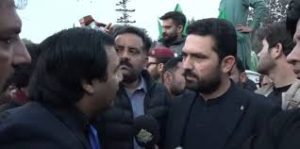
The Chief Minister of Khyber Pakhtunkhwa, Sohail Afridi, and his entourage displayed highly irresponsible conduct during their three-day visit to Lahore, behaving more like unruly street agitators than representatives of a provincial government.
Their actions reduced them to the level of gangsters, vagabonds, and clowns, making a mockery of their own office.
Afridi deliberately brought along a group of foul-mouthed hooligans whose sole purpose appeared to be chanting provocative and insulting slogans and hurling abusive and vulgar language at the Chief Minister of Punjab.
Instead of promoting inter-provincial harmony, the delegation sought confrontation.
Members of the entourage scuffled with police personnel and security guards, tore the uniform of one official, and attempted to force their way into the Punjab Assembly.
Their conduct was disorderly, uncivilized, and disgraceful. Many of these ruffians were without valid identification; some were reportedly accused in the May 9 anarchic violence and were not even on the official list of invitees.
Afridi and his team seemed desperate to project themselves as heroes by openly violating norms of decency, state protocol, and civilized behaviour. They attempted to inflame ethnic sentiments by playing the Pashtun card—an extremely dangerous and irresponsible tactic, unbecoming of a chief minister.
Adding insult to injury, Afridi had the temerity to complain that he was not treated with sufficient respect, nor accorded a rousing welcome or personally garlanded by the Chief Minister of Punjab. Such entitlement reflects a warped sense of propriety and an inflated ego.
He and his party members also expressed indignation over questions asked by journalists, labeling them offensive and objectionable. This is ironic, given that no group has been more aggressive, foul-mouthed, and abusive than PTI-affiliated journalists and social media handlers.
Despite relentless provocation, the Punjab administration demonstrated remarkable restraint and maturity. Full security and protocol were provided, and the KP delegation was free to visit any location of its choice.
The visit concluded peacefully solely due to the patience and professionalism shown by the Punjab authorities.
The Chief Minister of KP owes an unqualified apology and must pledge to conduct himself in a manner befitting the dignity of his high office. Instead of acknowledging the generosity and large-heartedness of the Chief Minister of Punjab—who tolerated blistering verbal attacks and abuse—Afridi chose confrontation.
Rather than appreciating Lahore as a glittering, well-managed capital and drawing lessons for improving the dilapidated condition of Peshawar, he resorted to casting aspersions. Worse still, instead of apologizing for his own misconduct and that of his unruly companions, he wrote an offensive letter to Maryam Nawaz demanding an apology from her.
In reality, Afridi was visibly disappointed by the poor public response he received in Lahore and across Punjab. He had expected massive crowds of cult followers flooding the streets, chanting slogans in favour of Imran Khan, and demanding his release. That expectation collapsed spectacularly.
The letter appears to be a face-saving exercise—an attempt to mask embarrassment over the complete failure to mobilize supporters, stir unrest, or paralyse the provincial capital.
One is left wondering when PTI leaders will finally learn from their repeated failures since May 2022, abandon their obsession with street violence, and shed their chronic habit of galam-galoch
in favour of mature, responsible politics.
Strategic Takeaway
The Lahore episode once again exposes PTI’s deep strategic bankruptcy. Confrontation, manufactured outrage, and street theatrics have repeatedly failed to yield political dividends since May 2022. Instead of recalibrating its approach, the party continues to rely on provocation, victimhood narratives, and mob mobilisation—tools that alienate the public, erode institutional credibility, and exhaust whatever political capital remains.
For a party aspiring to return to power, governance cannot be replaced by grandstanding, nor can abusive politics substitute for policy, performance, and statesmanship. The electorate is no longer receptive to chaos-driven politics; restraint, competence, and inter-provincial harmony are now the benchmarks by which leadership is judged.
Unless PTI undertakes a serious course correction—abandoning its culture of confrontation and internalising the discipline required for constitutional politics—it will remain trapped in a self-inflicted cycle of irrelevance, watching events unfold from the sidelines rather than shaping them.
The writer is a retired Brig, war veteran who fought the epic battle of Hilli in former East Pakistan. He is command & staff course and war course qualified, MsC war studies degree holder, he served as defence attache’ in Egypt and Sudan and also as the Dean of Corps of Military Attachés in Cairo. He is a defence, security and geopolitical analyst, columnist, author of five books, ex-chairman TFP, Patron-in-chief CDS Think Tank, Director Meesakh Research Centre, Chief Election Commissioner Tehreek Jawanan Pakistan, and takes part in TV talk shows .


