
From Epic Fury to Strategic Exhaustion: Reshaping Global Power Equations
By Asif Haroon Raja
Hot Question
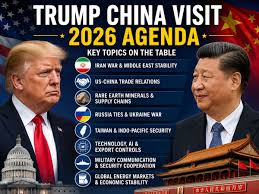
The burning question dominating strategic discourse is whether President Donald Trump will sign and finalise a peace agreement with Iran before departing for China on 15 May.
Hard Realities
The following strategic realities must be taken into account:
The US campaign, codenamed “Epic Fury,” has failed to achieve its principal war objectives despite carrying out more than 15,000 air strikes.
It neither succeeded in affecting regime change, nor compelling Iran’s capitulation through air power, nor collapsing its economy, nor denuclearising it, nor weakening China strategically.
The long-standing myths surrounding American air and naval invincibility, as well as the supposed impenetrability of Israeli air defences, have been seriously undermined.
Economic sanctions, blockades, and overwhelming military power proved insufficient against Iran’s resilience, strategic patience, and national willpower.
GPS spoofing, cyber warfare, and electronic warfare emerged as decisive instruments capable of neutralising technologically superior adversaries.
The overwhelming air superiority enjoyed by the US and Israel was offset by Iran’s extensive underground tunnel networks, hardened facilities, and subterranean missile cities.
The asymmetry between inexpensive indigenous Shahed drones and missiles on one side, and highly expensive interceptor systems on the other, has rendered the war economically unsustainable for both the US and Israel.
Iran’s asymmetric endurance, home-ground advantage, interior lines of communication, and comparatively secure logistics imposed strategic exhaustion upon the attackers, who suffered from stretched supply chains and vulnerable maritime logistics.
The US and Iran remain fundamentally divergent in their strategic outlooks, with little immediate prospect of genuine convergence.
Iran and China, however, remain longstanding strategic partners whose geoeconomic interests are deeply intertwined.
Iran does not pose a direct existential threat to the United States, nor was this originally America’s war. Washington was gradually drawn into the conflict and is now strategically trapped.
Neither side can decisively win the war, yet neither can afford outright withdrawal or capitulation because of the immense political and reputational costs involved.
Iran currently enjoys a psychological and political edge, having further eroded the prestige and credibility of the world’s sole superpower.
Despite Iran’s resilience and valour, sustaining prolonged attrition and conducting precision retaliation would have been difficult without covert technological, intelligence, and diplomatic support from China and Russia.
The strategic focus of the conflict has shifted from aerial warfare to the Strait of Hormuz. Iran’s threat of closure and the US naval blockade have severely impacted the geoeconomics of global trade and energy flows. The emphasis has consequently shifted from geopolitics to geoeconomics.
President Trump’s appeal for a multinational naval coalition to secure the Strait reportedly received little enthusiasm from several major powers, reflecting growing reluctance among allies to become entangled in another prolonged Middle Eastern conflict.
Saudi Arabia’s reluctance to permit unrestricted use of its airspace and military bases reportedly contributed to Washington’s decision to suspend the “Freedom Project.”
A prolonged stalemate suits both China and Russia strategically far more than it suits the United States.
The very fact that President Trump suspended the “Freedom Project” while simultaneously keeping diplomatic channels open indicates a recognition of strategic limitations. Washington may now seek an exit strategy framed as a political victory.
Both sides appear keen to freeze the conflict and stabilise maritime trade routes and energy corridors.
Although both sides desire de-escalation, any agreement is more likely to constitute a tactical pause rather than a permanent settlement.
The war is likely to end sooner rather than later, but at a substantial cost to American prestige and influence in the Middle East.
Both sides require face-saving arrangements; however, for Washington, such an outcome has become a strategic necessity because its global credibility is increasingly at stake.
The Aftereffects of War
The conflict has weakened the strategic standing of the US and Israel, strengthened Iran’s regional stature, and simultaneously enhanced the influence of China and Russia without either firing a direct shot.
Recognising the limits of prolonged resistance under economic and military pressure, Iran appears willing to place constraints on its nuclear programme for a limited duration, reportedly up to 15 years.
The Middle East is likely to witness profound geopolitical realignments in the aftermath of the conflict.
The GCC States have become increasingly vulnerable and insecure, compelling them to explore alternative security arrangements and mechanisms to ensure uninterrupted energy flows.
Emerging middle Muslim powers may gradually assume a greater role in the regional security architecture, potentially with strategic backing from China.
Domestic pressures within the US, combined with mounting international and Sino-Russian pressure, may eventually compel President Trump toward a negotiated settlement, as Washington can no longer afford another prolonged military confrontation.
During any future Trump–Xi Jinping engagement, China is likely to negotiate from a position of relative strength.
Washington may be compelled to reduce tariffs, ease sanctions, and reconsider aspects of its military posture in the Asia-Pacific.
Despite intensifying strategic rivalry, the United States and China remain deeply interdependent economically, and neither can achieve long-term stability or prosperity without some degree of mutual cooperation.
A Word About Pakistan’s Relevance
Pakistan has emerged from the crisis with enhanced strategic relevance owing to its geostrategic location, balanced diplomacy, and growing importance in regional connectivity and energy corridors.
Islamabad carefully avoided direct entanglement in the conflict while simultaneously safeguarding its national interests, regional stability, and strategic partnerships.
Pakistan’s policy of maintaining equilibrium between the Muslim world, China, the United States, and regional powers has strengthened its diplomatic space and increased its geopolitical utility.
The evolving regional environment offers Pakistan an opportunity to position itself as a bridge between the Middle East, Central Asia, South Asia, and China under emerging geoeconomic frameworks.
The weakening of unilateral American influence in the Middle East may create strategic openings for Pakistan to deepen defence, economic, and energy cooperation with regional states.
Pakistan’s close strategic partnership with China, combined with the significance of China-Pakistan Economic Corridor, has further elevated its importance in the larger Eurasian geoeconomic architecture.
The vulnerability of maritime trade routes through the Strait of Hormuz underscores the long-term significance of alternative trade and energy corridors passing through Pakistan.
Pakistan’s military preparedness, nuclear deterrence, and experience in hybrid warfare continue to make it a pivotal security actor in the wider region.
However, Pakistan must remain cautious of external attempts to destabilise its internal environment through economic pressure, information warfare, terrorism, and proxy conflicts.
In the emerging multipolar order, Pakistan’s future strength will depend not merely on military capability, but on political stability, economic resilience, technological advancement, and national cohesion.
About the Author
Brigadier (Retd) Asif Haroon Raja, SI (M) is a war veteran. He is Command and Staff Course and War Course qualified, holds an MSc in War Studies, and served as Defence Attaché in Egypt and Sudan, as well as Dean of the Corps of Military Attachés in Cairo.


