
“A Call for Dialogue, Reconciliation, and National Unity in Azad Jammu & Kashmir”
Americans of Azad Kashmir descent remain deeply concerned about the ongoing challenges in their homeland. A delegation representing the Kashmiri American diaspora from Virginia, Maryland, New Jersy and New York, held a ninety-minute-long meeting with Honorable Ahan Iqbal, Federal Minister for Policy and Planning and Special Initiatives, Government of Pakistan. Professor Ahsan Iqbal, who had previously participated in a delegation sent by the Prime Minister of Pakistan to engage with the leadership of the Joint Awami Action Committee (JAAC) in 2025.
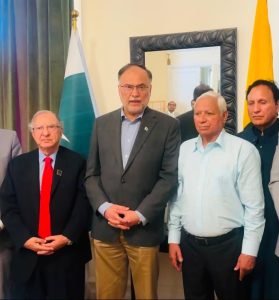
The delegation submitted a memorandum entitled, “A Call for Dialogue, Reconciliation, and National Unity in Azad Jammu & Kashmir” to Minister Iqbal intended for Hon. Mian Muhmmad Shehbaz Sharif, the Prime Minister of Pakistan. Ambassador Rizwan Saeed Sheikh, Pakistan’s Ambassador to the United States also attended the meeting.
The members of the delegation included the following: Dr. Ghulam Nabi Fai, Sardar Zarif Khan, Sardar Sawar Khan, Sardar Taj Khan, Sardar Shoaib Irshad, Aftab Shah, Imtiaz Kiyani, Farooq Qureishi, Sardar Aftab Roshan Khan, Syed Asad Hussain Gilani, Zaheer Qureisihi, Khan Abdul Waheed and Sardar Sajid Sawar.
The memorandum reads, “We, members of the Kashmiri diaspora community in the United States, write with profound concern over the recent developments in Azad Jammu & Kashmir (AJK). The gravity of the situation compelled us to seek a meeting with the Honorable Ahsan Iqbal, Federal Minister for Planning, Development and Special Initiatives, to share our perspective on achieving a peaceful and lasting resolution to the current crisis.”
The memorandum added that, “At the outset, we extend our deepest condolences to the families of all those who lost their lives during these tragic events. We make no distinction between civilians and members of the security forces. They were all sons and daughters of the soil of Jammu & Kashmir, and every life lost is a loss to us all. We also express our heartfelt sympathy to those who sustained injuries and respectfully urge the relevant authorities to ensure that every injured person receives the highest standard of medical care.”
The memorandum welcomed the Government of Pakistan’s decision to address one of the principal demands of the JAAC by providing subsidies on essential commodities and services, particularly electricity and wheat flour. We also appreciate the restoration of the health card program in Azad Jammu & Kashmir, a significant measure that will benefit countless families. These decisions demonstrate that dialogue can produce meaningful and positive outcomes.
The memorandum illustrates that “As members of the Kashmiri diaspora with deep roots in our ancestral homeland, we respectfully urge the Government of Pakistan and all relevant state institutions to initiate meaningful engagement with the leadership of the JAAC and other stakeholders. At this critical moment, dialogue, patience, and statesmanship offer the most effective path toward restoring confidence and preventing further hardship.”
It suggests that it is understandable that many participants in the recent protests have acted out of genuine concerns and strong emotions. During difficult times, emotions can sometimes outweigh careful judgment. This makes it all the more important for public institutions, political leaders, and community representatives to demonstrate restraint, encourage calm, and create opportunities for sincere and constructive dialogue.
The memorandum spells out that “There is no fundamental conflict between the people of Azad Jammu & Kashmir and the Pakistan Armed Forces. Both are united by shared history, common values, and an enduring commitment to the security, dignity, and future of Pakistan and the people of Jammu & Kashmir. Any differences that have emerged should therefore be addressed through understanding, mutual respect, and peaceful engagement rather than confrontation.”
The memorandum makes it clear that “Any prolonged tension or unnecessary use of force risks further loss of life and suffering. It may also weaken the broader Kashmir cause and diminish the sacrifices that generations of Kashmiris have made in pursuit of their legitimate aspirations.”
The memorandum emphasizes that “The people of Indian occupied Kashmir have endured immense hardship and have rendered extraordinary sacrifices over many decades. More than one hundred thousand lives have been lost in the struggle associated with the Kashmir dispute. Leaders such as Syed Ali Shah Geelani remained steadfast in advocating for the rights of the Kashmiri people. Mohammad Yasin Malik continues to face prolonged imprisonment. Shabir Ahmad Shah has spent decades in detention. Masarat Alam Bhat has repeatedly been detained under the Public Safety Act, while Aasiya Andrabi and her colleagues, Sofi Fehmeeda and Nahida Nasreen, have also faced lengthy imprisonment. These sacrifices continue to symbolize the resilience and determination of the Kashmiri people.”
The memorandum acknowledges that the leadership of the JAAC has consistently advocated for the welfare and concerns of the people of Azad Jammu & Kashmir. At this important juncture, we respectfully encourage the leadership of JAAC to continue providing responsible and peaceful leadership. With many prominent Kashmiri leaders in Indian occupied Kashmir no longer among us or facing prolonged incarceration, there is an opportunity to elevate the Kashmir issue once again—both within Pakistan and before the international community—through peaceful, democratic, and principled advocacy.
The memorandum stresses that “We are equally mindful that continued unrest may provide hostile elements with an opportunity to misrepresent Pakistan before the international community by drawing misleading comparisons with the human rights concerns that Pakistan has consistently highlighted in Indian-occupied Kashmir. Such narratives would neither serve Pakistan’s national interest nor advance the cause of the Kashmiri people.”
The members of the delegation, therefore, respectfully appeal to all stakeholders—the Government of Pakistan, the institutions of the State, the leadership of the JAAC, political representatives, civil society, and community leaders—to pursue a balanced, peaceful, and mutually acceptable resolution through dialogue, reconciliation, and mutual respect. Such an approach will strengthen national unity, preserve public confidence, and reinforce Pakistan’s longstanding and principled position on the Jammu & Kashmir dispute.
We have full confidence that Pakistan’s leadership will continue to act with wisdom, foresight, and compassion in addressing this challenging situation. We sincerely hope that every possible effort will be made to restore peace, safeguard the welfare and dignity of the people of Azad Jammu & Kashmir, and strengthen the unity that has always been the foundation of our collective resolve.
We truly believe that history will judge us not by the divisions we inherited, but by the wisdom and compassion with which we chose to overcome them. We remain confident that, through dialogue, justice, and national unity, Pakistan and the people of Jammu & Kashmir can emerge from this moment stronger and more united than before.
Professor Ahsan Iqbal appreciated the concerns raised by the Kashmiri diaspora delegation. He observed that there exists a broad national consensus on the issue of Jammu and Kashmir and reaffirmed Pakistan’s unwavering commitment to supporting a peaceful resolution of the Jammu and Kashmir dispute in accordance with the aspirations of the Kashmiri people. He emphasized that all institutions of the State of Pakistan would continue to employ all available diplomatic means to advance this objective.
The Minister Ahsan Iqbal assured the delegation that the memorandum submitted by them would be forwarded to the Prime Minister of Pakistan together with his observations.
The Minister informed the participants that he had been a member of the delegation which met the leadership of the Jammu and Kashmir Joint Awami Action Committee (JAAC). Referring to the issue of the 12 Muhajireen seats, he stated that the delegation had conveyed its preference for resolving the matter amicably and through dialogue. In this context, the following options were proposed:
i. As the matter is of a constitutional nature, it may be addressed through the elected Legislative Assembly of Azad Jammu and Kashmir.
ii. JAAC may seek adjudication by the Supreme Court, and all stakeholders should accept and abide by the Court’s judgment.
iii. JAAC may convene an All Parties Conference in Azad Jammu and Kashmir with a view to developing a mutually acceptable solution.
iv. JAAC may nominate two senior jurists, alongside two senior jurists from Azad Jammu and Kashmir and two representatives nominated by the Government of Pakistan, to examine the matter and formulate recommendations for its resolution.
The Minister reiterated that the Government remains fully committed to resolving all outstanding issues, including the matter of the 12 Muhajireen seats, through dialogue, consultation, and constitutional means rather than confrontation. He further noted that all four options remain open for consideration and constructive engagement.
May Allah Almighty guide us all toward decisions that promote peace, justice, compassion, and prosperity for the people of Pakistan and Jammu & Kashmir.


