
A Journey of Friendship, Commitment, and Advocacy for Kashmir
by Dr. Ghulam Nabi Fai Chairman
World Forum for Peace & Justice
There are occasions when friends arrange lectures and important meetings for you because you have come from abroad. But it is entirely different when a friend himself undertakes a journey of nearly four hours, driving from Palandri to Islamabad—not merely to meet you, but to personally ensure that his invitation and program are fully approved and successfully arranged.
Such is the exceptional case of Justice Sardar Abdul Hamid Khan of Palandri. Justice Sardar Abdul Hamid Khan, former Judge of the Azad Jammu & Kashmir High Court, is remembered with deep respect for his integrity, wisdom, and unwavering commitment to justice. He upheld the rule of law with dignity and impartiality, earning the trust of the legal fraternity and the public alike. His judicial legacy continues to inspire those who believe in fairness, constitutional values, and an independent judiciary.
While I was still in Washington, Justice Sahib called me twice, insisting that I must visit Palandri so that he could organize lectures on Kashmir. True to his word, he undertook the long journey himself, solely to confirm my participation. This friendship is unique in nature and reflects nothing but the sincerity, affection, and deep commitment of Justice Sahib to the cause of Kashmir. I remain profoundly grateful for this extraordinary gesture.
According to our schedule, we were to arrive in Palandri on Tuesday, August 2, around 5:00 p.m. However, due to an intense schedule in Islamabad—and an important, highly interactive event at the Islamabad Bar Council—we could not depart Islamabad until 4:00 p.m. Our delegation included Dr. Waleed Rasool, an academic and Kashmiri scholar; Sardar Zulfiqar Roshan Khan, founding member of the Kashmir American Welfare Association (KAWA); Sardar Zubair Khan, Director of Voices of Justice in Kashmir and Mohammad Maruf, young, friendly and energetic entrepreneur.
We reached Palandri around 8:00 p.m. We were informed that Justice Hamid had organized a large seminar on Kashmir at 6:00 p.m., with over 400 invitees, which unfortunately had to be canceled due to our delayed arrival. Nevertheless, Justice Hamid graciously hosted a gathering at his residence, inviting several dozen prominent citizens of Palandri, including academics, university scholars, businessmen, senior government officials, and community leaders. The discussion on Kashmir was deeply engaging and lasted over three hours, concluding with a memorable home-cooked dinner.
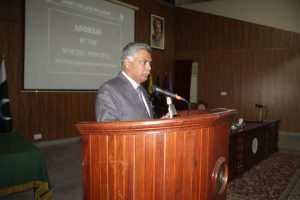
On Wednesday, December 3, we were invited by Brigadier (Retd.) Wajid Qayyum Paracha to address the cadets of Cadet College Palandri on the topic: “Why should the world care about Kashir?” The Principal, Brig. Paracha Sahib, kindly briefed us about the institution.
He explained that Cadet College Palandri is situated in beautiful natural surroundings, approximately 100 kilometers from Islamabad, spread over 60 acres. The campus includes a double-storied academic block, five hostels, cadets’ mess, and an administrative block, along with residential accommodation for staff. The college offers extensive outdoor sports facilities, including hockey, football, volleyball, basketball, cricket, and an athletic track. It also boasts a state-of-the-art gymnasium with facilities for weight training, indoor badminton, volleyball, and basketball, as well as an international-standard squash court.
Pricipal Sahib added that admissions are made annually in Class VIII through a competitive examination, with classes commencing in the second week of April. Each year, 93 cadets are inducted. The quota system includes 12 seats for refugees and 3 open seats for students from Indian-occupied Kashmir.
In my address, I focused on the latest confrontation between India and Pakistan, which brought both countries to the brink of a nuclear catastrophe. I emphasized that when the Kashmir conflict poses a threat to international peace and security, it ceases to be merely a bilateral issue and becomes an international concern. The evidence lies in the fact that President Donald Trump personally intervened, calling the Prime Ministers of India and Pakistan and brokering a ceasefire. President Trump publicly acknowledged the danger of nuclear confrontation and stated that Kashmir was the core issue, even offering his office for mediation.
Similarly, U.S. Secretary of State Marco Rubio, who also serves as the National Security Advisor, stated in May 2025 that the time had come for the National Security Advisors of India and Pakistan to meet at a neutral venue to resolve outstanding issues. This is why, I stressed, the world must talk about Kashmir.
We must speak about Kashmir because the people of Kashmir cannot speak freely about Kashmir in Kashmir. Anyone who dares to raise their voice against the Indian military risks arrest and imprisonment far from home. I cited the case of Khurram Parvez, who documented atrocities committed by the Indian army in his 549-page book “Torture: Indian State’s Instrument of Control in Indian-Administered Jammu and Kashmir.” He was arrested on November 22, 2021, under the Unlawful Activities (Prevention) Act (UAPA). Yet Time Magazine listed him among the 100 most influential people in the world, and Mary Lawlor, UN Special Rapporteur on Human Rights Defenders, categorically stated: “Khurram Parvez is not a terrorist; he is a human rights defender.”
I also spoke about Yasin Malik, who was invited by former Indian Prime Minister Dr. Manmohan Singh to participate in peace talks. Under official instructions, Malik met senior officials at the U.S. State Department and National Security Council before traveling to Pakistan. Today, he has been sentenced to two life imprisonments, with the current Indian government seeking the death penalty.
Likewise, Shabir Ahmad Shah, declared a prisoner of conscience by Amnesty International, has spent over 38 years in prison—a figure many rightly call the Nelson Mandela of Kashmir. Masarat Alam has been subjected to the Public Safety Act 35 times. Aasia Andrabi who was arrested on July 6, 2018 for calling fo the implementation of UN resolution on Kashmir. When such leaders and the people of Kashmir are silenced, it becomes our moral duty to speak for them.
Later, we addressed the Palandri Bar Council at the invitation of Advocate Zareef Aslam, President, and Advocate Arsalan Nisar, Secretary General. Dr. Waleed Rasool discussed the legal dimensions of the Kashmir issue and the vital role the AJK legal fraternity can play. Sardar Zulfiqar Roshan Khan highlighted recent peaceful public protests in Azad Kashmir, emphasizing the constructive role lawyers can play in organizing lawful civic movements. Sardar Zubair Khan outlined the mission of Voices of Justice in Kashmir, an organization founded by Americans of Azad Kashmir heritage to mobilize advocacy efforts in Azad Kashmir and Pakistan.
I concluded by warning that Hindutva ideology now permeates Indian-occupied Kashmir. Through India’s new Domicile Law, demographic engineering is underway, threatening to reduce Kashmir’s Muslim majority to a minority—a deliberate attempt to alter the region’s identity.
Our final engagement was at Mirpur University of Science and Technology (MUST), Palandri Campus, organized by Professor Munawar Hashmi, Nimra Maqsood, a young and promising scholar of International Relations and Nouman Siddiqui, son of renowned intellectual, Dr. Abdul Aleem Siddiqui. All members of the delegation addressed students and faculty.
Justice Sardar Abdul Hamid Khan graciously hosted the entire delegation at his residence, extending warmth and hospitality throughout our stay.
Dr. Fai expressed gratitude to Justice Sardar Abdul Hamid Khan for his hospitality and leadership, noting that the engagements reflected a strong commitment within Azad Kashmir to ensuring that the voice of the Kashmiri people continues to be heard.
Overall, Wednesday, December 3, was a day filled with meaningful engagements. Every moment carried a clear message: the people of Kashmir must not be forgotten—least of all by the people of Azad Kashmir.
Dr. Ghulam Nabi Fai is also Secretary General World Kashmir Awareness Forum


