
Criminalizing Dissent in Kashmir: Property Confiscation and the Politics of Fear
By Dr. Ghulam Nabi Fai, Chairman World Forum for Peace & Just
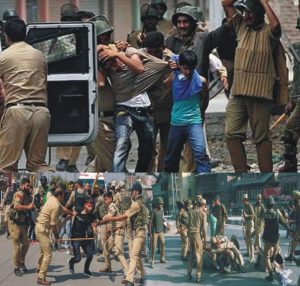
The principle that an occupying power does not become the sovereign owner of the territory it controls is well-established in international law. An occupier’s role is temporary administration, not ownership, domination, or the rewriting of the political identity of a people. Yet in Kashmir today, we witness a troubling departure from this foundational rule — one increasingly expressed through punitive property seizures, land attachments, and coercive legal actions aimed at silencing dissent and intimidating voices at home and abroad.
Mahatma Gandhi once reminded India that true sovereignty resides with the people, not with rulers. Speaking in Delhi on July 29, 1947, he declared, “The real sovereign of the State are the people. The ruler is a servant of the people. If he is not so, then he is not the ruler… In Kashmir too, the power belongs to the public. Let them do as they want.” Gandhi’s words were a moral indictment of colonial rule — but they also carry meaning for the present. If political authority today claims sovereignty over Kashmir while denying its people agency, dignity, and participation, then it contradicts both the ethical spirit and democratic foundations that Gandhi articulated.
International law reinforces this moral truth. Article 33 of the Fourth Geneva Convention prohibits collective punishment and makes clear that no civilian may be penalized for an offense they did not personally commit. The Convention applies to all situations of occupation, recognized or not, and it safeguards both civilians and their property. UN Special Rapporteurs, human-rights bodies, and international courts have repeatedly affirmed that punitive evictions, demolition of homes, revocation of residency rights, and seizure of land as retaliation for political opinion or peaceful activism violate international legal obligations and may amount to serious human-rights abuses. Forced eviction, as the UN Special Rapporteur on adequate housing has emphasized, constitutes a gross violation of human rights.
Yet in Kashmir, the trajectory is moving in the opposite direction.
Over recent years, there has been a marked increase in property attachments and asset seizures — many of them justified under broad security narratives and enforced through domestic criminal laws such as the Unlawful Activities (Prevention) Act (UAPA). These measures are not only punitive in character; they reshape a political dispute into a regime of control. Dr. Syed Nazir Gilani, President of the Jammu and Kashmir Council for Human Rights (JKCHR), has argued that New Delhi lacks the legal authority to seize assets in a territory recognized internationally as disputed, and that what was historically framed as a protective mandate has now hardened into a punitive and coercive order.
This trend has not spared the Kashmiri diaspora. Increasingly, ancestral properties belonging to overseas Kashmiris engaged in peaceful political advocacy are being attached or threatened with seizure. A recent case cited by Dr. Syed Nazir Gilani, President JKCHR involves the attachment of land belonging to U.S.-based Kashmiri leader Dr. Ghulam Nabi Fai in Budgam — one of several incidents that have triggered public debate across Kashmir. Similar actions have reportedly affected the properties of Dr. Syed Nazir Geelani, Ershad Ahmed Malik, and Raja Muzaffar Khan — individuals known not for violence, but for advocating a peaceful resolution of the Kashmir dispute in accordance with UN Security Council resolutions.
These actions are not isolated administrative measures. They form part of a broader pattern — one that increasingly resembles transnational repression. Families are pressured inside Kashmir for speech expressed abroad. Property becomes a lever of intimidation. Law becomes an instrument of deterrence rather than justice.
The message such tactics send is unmistakable: dissent carries a cost, and even peaceful advocacy may invite retribution. But history shows that coercion imposed upon a people rarely produces stability, consent, or legitimacy. Instead, it deepens alienation, hardens grievances, and distances political power from moral authority.
There is another, deeper irony. The state that once rejected colonial dominance now risks replicating its logic in a territory whose people continue to assert their political identity and rights. A politics built on property confiscation, collective punishment, and enforced silence may exercise control — but it cannot command respect, nor can it erase memory, dignity, or aspiration.
Despite pressure, intimidation, and punitive measures, the resolve of the Kashmiri people has not disappeared. Property can be seized, but conviction cannot be confiscated. Homes can be attached, but the human yearning for dignity and self-determination remains beyond the reach of administrative orders. The struggle in Kashmir — however one interprets its political future — is ultimately rooted in the principle Gandhi himself affirmed: sovereignty belongs to the people.
Whether the world chooses to engage with that principle, or to overlook the erosion of law and morality taking place before our eyes, will shape not only the future of Kashmir — but the credibility of the very norms we claim to defend.


