
The US-Israel War Against Iran: Its Consequences Part-3
By Asif Haroon Raja
Many a Slip between the Cup and the Lip
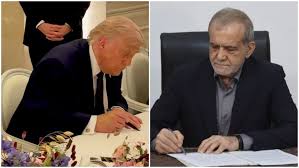
President Donald Trump attended the G7 Summit of the world’s leading advanced economies, which this year was held in Europe.
During a press interaction on 15 June, Trump appeared alongside a Qatari representative. Observers noted his visible discomfort when questioned about Israel’s position regarding a possible settlement with Iran, reflecting what appeared to be emerging differences between Washington and Tel Aviv over the desired end state of the conflict.
Responding to questions about America’s role, Trump remarked that “without the United States there would be no Israel.” He then went one step further and said, ‘without him there will be no Israel’.
Explaining this , Trump told journalists that without him Iran would have destroyed Israel by now if he had not made a deal with Iran. He further suggested that his diplomatic efforts had prevented a far wider regional war, and his negotiations with Tehran had helped avert circumstances that could have posed a serious threat to Israel’s security.
Israel as a Strategic Liability
The conflict intensified debate within the United States regarding the costs and benefits of unconditional support for Israel. Concerns over the risk of regional escalation, growing military commitments, and the financial burden of prolonged involvement have generated criticism across sections of the American political spectrum.
Trump himself appeared to signal dissatisfaction with some of Prime Minister Netanyahu’s policies when he stated, “What Netanyahu is doing in Lebanon, I do not like. He should stop it.”
While Israel continues to enjoy strong bipartisan support within the American political establishment, a growing segment of the public increasingly questions whether Washington’s close alignment with Israeli policies serves long-term American interests.
Israel is now a nuisance in the eyes of ordinary Americans. They view Israel as a liability rather than a strategic asset.
Western Media Snipes
A segment of western analysts have opined that the countries of the world will remember that attacking Iran was the biggest blunder, which has paved the way for the downfall of the Israeli prime minister, and the beginning of the fall of the American empire.
The British Telegraph newspaper reported – ‘thirteen thousand air strikes for what’? This report repeatedly asked what America gained and what it lost in this war.
The BBC reported: “The Iran deal ends Trump’s war that revealed the limit of US dominance”.
Some commentators interpreted the conflict as evidence of the gradual erosion of unchallenged American dominance rather than the imminent collapse of US power.
British geopolitics analyst Alexander said that Netanyahu will lose power in the October elections, and Trump has emerged in all American polls as an extremely unpopular president even in his own country.
Some observe that Iran has gained more from the war than it expected, while the US has lost more than it feared.
They argue that when the war started, everyone thought America would wipe out Iran. It didn’t happen and according to some, Israel or America will never again think of striking Iran.
In the words of American University of Chicago Professor Pape, ” Iran will become a superpower in the world 18 months from now”.
Limits of American Power
The war revealed the limits of US dominance. The conflict demonstrated that even the world’s most powerful military coalition faces constraints when confronting a large, resilient, and strategically positioned regional power. Military superiority alone does not automatically produce political outcomes.
Strategic Outcome
Many of the more optimistic forecasts regarding Iran’s future should be treated with caution.
Predictions of a dramatic shift in the regional balance of power remain speculative and depend upon several uncertain variables, including sanctions relief, regional stability, energy prices, and the durability of any future peace arrangement.
Nevertheless, if sanctions are eased and tensions continue to subside, Iran could emerge as one of the principal beneficiaries of the post-war environment.
Possessing vast energy reserves, a sizable industrial base, and a strategically important geographic position, Iran would be well placed to expand both its economic and geopolitical influence.
The conflict demonstrated that Iran could not be coerced into surrender through military pressure alone and reinforced the importance of diplomacy in resolving major regional disputes.
Strategic Conclusion
The conflict has increased political pressures on both Netanyahu and Trump while simultaneously reshaping perceptions of power across the Middle East and the wider developing world.
The most enduring consequence of the war may not be territorial gains or military achievements, but rather the widespread perception across much of the developing world that Iran withstood sustained pressure from two technologically superior adversaries without capitulating to their demands.
Whether this resilience translates into lasting geopolitical influence remains uncertain. However, the conflict has already altered regional calculations regarding deterrence, strategic endurance, and the limits of military power in achieving political objectives.
The war has also highlighted an enduring lesson of international politics: military superiority can shape the battlefield, but it does not always determine the political outcome.
In that respect, the conflict may be remembered less for the destruction it caused than for the strategic questions it raised about the future balance of power in the Middle East and the evolving limits of American influence.
About the Author
Brigadier (Retd) Asif Haroon Raja, SI (M) is a war veteran. He is Command and Staff Course and War Course qualified, holds an MSc in War Studies, and served as Defence Attaché in Egypt and Sudan, as well as Dean of the Corps of Military Attachés in Cairo.
He is a defence, security, and geopolitical analyst, columnist, featured columnist of IntelDrop magazine Washington, author of five books, former Chairman of Thinkers Forum Pakistan, Patron-in-Chief of Centre for Development Studies Think Tank, Director of Meesakh Research Centre; he regularly appears on media platforms.


